
The framework was built in a holding cell.
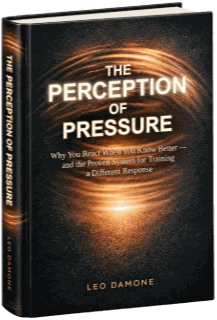
Before coming home in 2009, Leo Damone spent his incarceration studying one question his life had forced on him. Why do I keep doing what I tell myself I won’t do? What he built in that space became Reaction Readiness, and later, The Perception of Pressure.

Hear it from Leo.
The whole story, from the holding cell to the framework, in his own words.
 Watch the origin story
Episode 0: Why You Know What to Do—But Still Don’t Do It
The cement was cold.
That’s the first thing I remember.
Cold, unforgiving concrete pressing against my back as I laid in a holding cell, waiting to be processed for a prison sentence I had earned.
I didn’t lose my intelligence in that cell.
I lost access to it.
The Perception of Pressure, IntroductionWhat was found inside the fire.
Inside prison, Leo had something most people never get: time with no escape from the question. Not a philosophical question. A survival question, with consequences he was already living.
Eighteen-hour study days. Any book he could get his hands on, and every study group that would let him sit in. Across all of it, he found the same pattern in every person, whatever they believed, wherever they came from, however much they knew.
The gap between knowing better and doing better. Between who someone was and who showed up when pressure arrived.
That gap was not a character problem. It was a perception problem and a training problem. He set out to build the training.
From the floor to the framework.
- The origin
Sentenced to a prison term, he studied every waking hour of it. The pattern appeared in every source he read.
- Coming home
Released with two felonies. The framework was already in development. The study did not stop. The application began.
- The application
Fourteen years designing stability systems for Fortune 500 companies running at peak demand, Amazon, Tesla, and CarMax being a few. He started on a warehouse floor and built systems that had to hold before the pressure arrived to test them.
- The framework
Reaction Readiness and The Perception of Pressure. Formal validation of the Scorecard in partnership with the VCU Evaluation Laboratory. Speaking, youth development and community work.
“That which I don’t want to do, I do.”
Paul of Tarsus, about 57 AD
Inside, during his cross-tradition study, Leo met Paul’s confession in Romans 7:15. He read it as an honest observation of how people work under pressure.
A first-century writer described the same gap Leo was living: the response that runs faster than your intention, that you didn’t choose and often regret. Two thousand years apart. The same gap. Now there is a system for training through it.
“You cannot build a system that holds under maximum pressure — during maximum pressure.”
The Perception of Pressure, Chapter 13His job was to build systems that held at peak load, before the peak arrived. He was solving for industrial infrastructure, and without knowing it, he was solving the same problem for the human body.
Real rooms. Real stakes.
VCU Evaluation Laboratory
The Scorecard is in formal validation, in partnership with the VCU Evaluation Laboratory. The framework is built to hold up to scrutiny.
Virginia Department of Corrections
Invited to speak through the VADOC Speakers Bureau to teams across corrections and community probation and parole.
Richmond Public Schools and Boys & Girls Club
Youth development work that brings the language in early, before the patterns harden.
Peer Recovery Specialist
Virginia board-certified to provide peer support. The framework is grounded in lived experience.
Trusted by




The framework he needed in 2009. Available now.
Start where every reader starts. Find out what pressure does to your access.